Tires never get much thought until something goes wrong: a blowout on a mountain grade, a fuel bill creeping upward month after month, a trailer that won't grab in the rain. Most of those problems trace back to one quiet decision made at the tire counter months earlier. For an owner-operator, tires are one of the few purchases that touch cost, safety, and uptime all at once — and they're too often bought on price alone or on whatever the supplier had in stock.
Here's the truth: there is no "right tire" in the abstract. The right tire exists only in relation to three things — where you drive, what the ground looks like when you get there, and how much weight you're hauling. Get those three right and the choice mostly makes itself.
Start With the Route, Not the Catalog
Most buyers flip through a brand lineup and pick something that looks tough. That's backwards. The route comes first, because it decides what the tire will actually live through: temperature swings, road surface, grades, and average speed all shape which compound and tread pattern hold up.
Long, flat interstate runs favor harder compounds and shallower, more efficient tread — there's less need for aggressive traction and more to gain from lower rolling resistance. Stop-and-go regional work chews tread unevenly and rewards a softer compound that grips at low speeds, even if it gives up a little fuel economy.
Elevation matters too, and it gets overlooked constantly. Sustained climbs and long descents pour heat into a tire. If your lanes include real grades, that alone should push you toward a tire rated for higher heat tolerance — regardless of what the rest of the route looks like.
Terrain Changes the Physics, Not Just the Label
"All-terrain" and "all-season" are shorthand, not answers. Terrain means moisture, temperature, and surface consistency — and every one of them changes what the rubber needs to do.
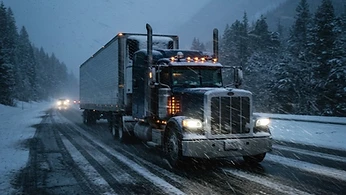
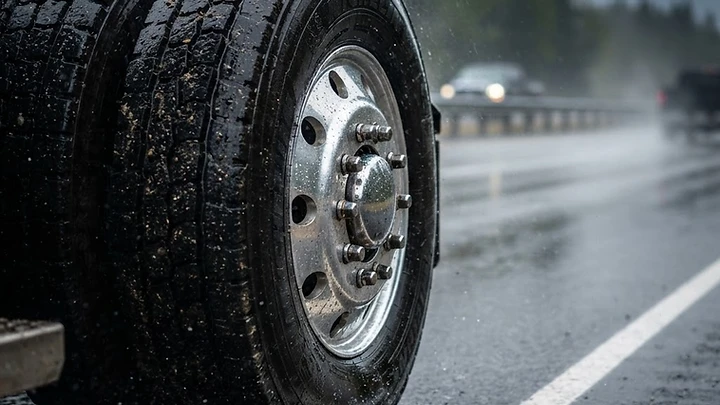
In wet or icy country, tread depth and siping are what move water and hold grip. A tire that looks fine on a dry lot can hydroplane the moment rain hits because it can't displace water fast enough. That's why a casing that "still has some life" by dry-road standards may already be a liability somewhere wetter.
Loose surfaces — gravel, job sites, unpaved yards — want deeper, wider-spaced tread blocks that resist packing with debris. The trade-off: more rolling resistance and heat back on pavement. Fleets on mixed routes usually land on a moderate tread that gives up a little on both ends rather than hard-optimizing for one condition and paying for it everywhere else.
Temperature extremes add the last layer. Rubber stiffens in cold and softens in heat, changing both grip and wear. Winter-rated tires use a different compound entirely — the rubber has to stay pliable at low temps to keep contact with the road.
Weight Is the Variable Everyone Underestimates
Load is where fuel economy and safety intersect most directly — and it's the factor most often mismatched.
Under-rated or underinflated tires carrying heavy loads flex beyond design, generate excess heat, and accelerate wear. In the worst case that's tread separation or a blowout at highway speed. It also drags fuel economy down several percentage points, which compounds fast when it's your truck and your fuel card.
At the other end, over-spec'd tires aren't dangerous, just wasteful — thicker sidewalls and tread than the job needs, adding rolling resistance with no benefit. Like running a heavy-duty pickup to deliver one envelope.
The practical fix: match load range to your realistic average load, not your peak. A truck that occasionally runs near its limit but usually runs well under it doesn't need max-rated rubber — it needs tires rated for the typical load with margin for the occasional heavy run. Check pressure against the actual load too, not just a number on the door frame. An underinflated tire behaves like an under-rated one, and pressure checks are the cheapest tire maintenance there is.
Bringing It Together
None of these three factors works in isolation. A tire picked for mountains but not for your typical load still overheats. A tire matched to load but not to seasonal terrain handles poorly the first time conditions shift. The tires that quietly save money are the ones chosen after route, terrain, and weight are mapped together.
Keep a written record of your usual lanes, seasonal shifts, and average versus peak loads, then check your tire specs against it once a year. Not glamorous — but it's the difference between tires that go the life of the tread and a fuel-bill surprise or roadside emergency six months in.